
The right campaign planning tool for a one-person marketing team should help you turn a clear brief into researched decisions, reviewed content and a measurable next step. Compare tools by running one small campaign through the whole workflow. Check how much context you must copy, how easily you can verify claims, and what happens when the plan changes.
A long feature list does not answer those questions. A calendar might organise publication dates well while leaving research elsewhere. A writing assistant might produce drafts quickly while making you manage approvals and results separately. Either can be appropriate if it solves the part of the process that is slowing you down.
This guide offers a practical selection method, not a scored ranking of vendors. It supports our explanation of what a research-backed campaign workspace does.
Start with the campaign you can actually run
Write a short brief before evaluating software. Name one audience, one offer, one desired action and the time you can spend each week. Record your available budget with its currency, even if the first campaign is entirely organic.
For example, imagine a small B2B service firm testing a workshop offer through one helpful article, three LinkedIn posts and an opted-in email. This is an illustrative scenario, not a Tractn customer result. Its software requirements are concrete: preserve the offer, check the evidence, review the assets, manage delivery and inspect enquiries.
List the friction in your current process. Do you lose sources, repeat company information, forget which draft was approved, or struggle to connect enquiries with a campaign? Prioritise the two problems that consume the most effort. Do not buy a broader system simply because it contains more modules.
Compare tools using six workflow checks
Use the same brief in each candidate. Record what you actually observed rather than awarding points from a sales page.
| Check | Practical test | Evidence to keep |
|---|---|---|
| Company context | Enter your offer, audience and writing rules, then open another campaign | Which details remain available and editable |
| Research | Follow a claim back to its source | Source URL, date, relevant market and any coverage limitation |
| Planning | Explain why a channel and message were chosen | A decision linked to evidence or clearly labelled as a hypothesis |
| Content review | Revise a draft against the approved plan | A reviewable final version and its approval state |
| Delivery | Inspect a scheduled item and its destination | Connected account, timing, status and failure handling |
| Measurement | Trace a reported outcome to a recorded event | Definition, reporting period, source and exclusions |
Score each check as observed, partly observed or untested. Untested is a useful answer: it identifies what to ask the vendor or verify before committing. Avoid turning your impressions into precise performance scores that the trial did not establish.
Check whether research can be verified
A research summary is more useful when you can inspect its inputs. Open several citations. Confirm that each source supports the claim beside it, applies to the relevant market and is recent enough for the decision.
Distinguish provider measurements from estimates and generated suggestions. A keyword opportunity is not a traffic forecast, and a confident audience description is not customer validation. Ask what the tool shows when a connector fails or a source is unavailable.
For your own articles, Google's people-first content guidance recommends useful, original information and clear sourcing. Apply that editorial standard to research-assisted drafts: the output should help a reader make a decision, not merely reproduce summaries.
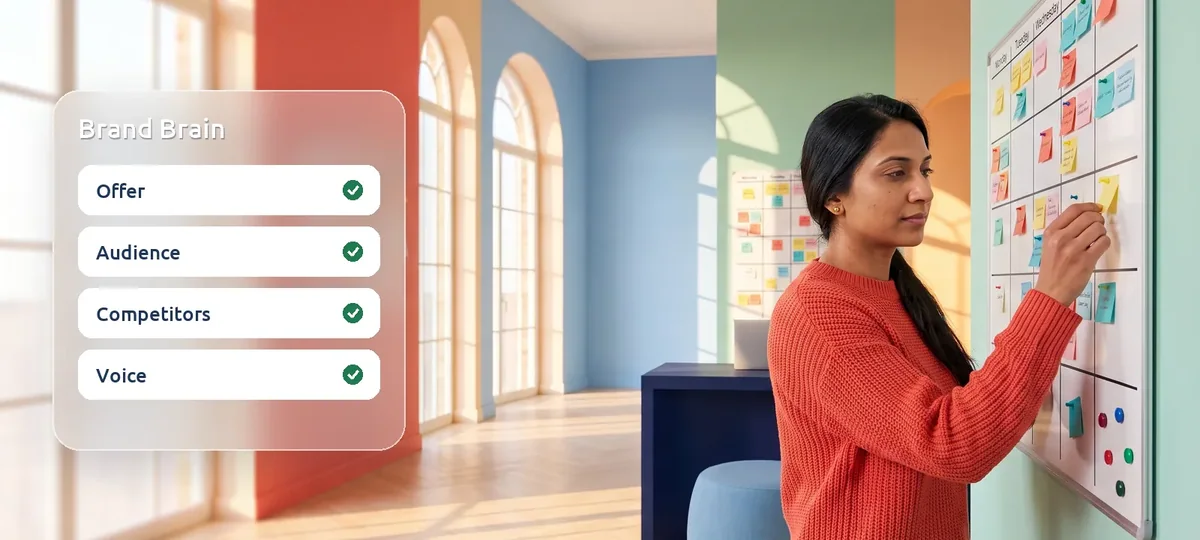
In Tractn, Brand Brain supplies company context to the campaign process. Review that context before generating work; incomplete inputs can make an otherwise polished plan irrelevant.
Test a change, not just the first draft
After creating a plan and one draft, change an important assumption. In the workshop example, replace the general founder audience with operations managers in a specific industry. Then check the headline, examples, call to action and selected channel.
Does the tool help you see which work depends on the original audience? Can you preserve the reviewed version while preparing a revision? Is the final publishing decision still clear?
Automation need not update every asset immediately to be useful. You need a dependable way to identify affected work and review it. Our strategy and content alignment checklist provides a repeatable approach to this test.
Inspect publishing and email boundaries
Treat creation, scheduling and successful delivery as separate states. A draft in a calendar is not proof that it will publish. Check the account connected to the item, the time zone, required media and any approval step.
The Tractn workflow guide explains how campaign stages fit together. Use it to distinguish planning work from the delivery checks you still need to perform.
For email, ask how consent, unsubscribe requests, failed sends and repeat enrollment are handled. Use a test inbox you control. Verify receipt and links rather than relying only on an accepted-by-provider message. Do not upload a real contact list simply to explore a trial.
If you already have reliable publishing and email tools, assess whether the new product fits alongside them. Replacing a working service can create migration work that outweighs a small improvement elsewhere.
Compare total effort as well as price
Use the actual billing terms for your intended plan. Record currency, billing period, seats, usage limits and the features included. An annual monthly equivalent is not the same commitment as monthly billing. Recheck prices when deciding; this article deliberately does not quote vendor prices that may change.
Also count setup and maintenance: entering brand context, connecting accounts, checking drafts, fixing failed deliveries and reviewing results. A sensible trial question is whether you can complete your chosen campaign with a process you understand and can repeat.
Choose the simplest option that passes your essential checks. A document and calendar can be enough for a very small campaign. A connected workspace becomes more valuable when coordinating research, decisions and revisions is the recurring problem.
Frequently asked questions
What is a campaign planning tool?
It is software used to organise campaign objectives, audiences, activities and timing. Some products also connect research, content, approvals and reporting. Verify which stages are included rather than assuming every planning tool handles delivery.
What should a solo marketer test first?
Run one realistic brief through research, planning and a reviewed draft. Change one assumption and inspect the effect on that draft. This exposes coordination work that a feature demonstration may not show.
Do I need an all-in-one marketing platform?
Not necessarily. Keep tools that already work well. Consider a connected platform when repeated context copying, inconsistent decisions or scattered reviews are costing you time, and test whether it reduces those problems.
Can AI approve the campaign for me?
AI can assist with research and drafting, but you should verify claims, audience suitability, permissions and delivery settings. A generated plan is a proposal until someone responsible reviews it.
How can I try this workflow in Tractn?
Create your company context, research a campaign, review its plan and prepare one asset. Create a Tractn account and use the workflow guide to follow the stages. Check current plan limits before expanding the campaign.
Sources and further reading
- Google Search Central: Creating helpful, reliable, people-first content — editorial guidance on usefulness, originality and sourcing; accessed 3 October 2026.
Tractn documentation
- Tractn: What a research-backed campaign workspace does — parent topic and connected workflow.
- Tractn: Keeping strategy and content aligned — reviewing changes across a campaign.
- Tractn: Brand Brain and workflow orchestration — product documentation for the steps described here.